
If you want to improve your financial situation, one of the most important skills you need to learn is budgeting. Budgeting is the process of planning how you will spend your money each month, based on your income and expenses. In this blog post, we will cover the basics of budgeting, the benefits of budgeting, some tips to create and maintain a budget, and a success story from a real person who used budgeting to achieve her goals.
What is budgeting?
A budget is a financial tool that helps you assess your income and spending, and set realistic financial goals. There are different types of budgets, such as traditional, reverse, and zero-based. You can choose the one that works best for you.
- Traditional budgeting: This approach involves dividing your expenses into fixed and variable categories, and allocating a percentage of your income to each category. For example, you might spend 50% of your income on fixed expenses (such as rent, utilities, and debt payments), 30% on variable expenses (such as food, entertainment, and clothing), and 20% on savings and investments.
- Reverse budgeting: This approach involves setting aside a specific amount of money for your savings and investments first, and then spending the rest of your income on your expenses. For example, you might save 20% of your income for your retirement fund, emergency fund, and other goals, and then spend the remaining 80% on your fixed and variable expenses.
- Zero-based budgeting: This approach involves assigning every dollar of your income to a specific purpose, such as an expense, a saving, or a debt payment. For example, you might allocate $1,000 for your rent, $500 for your groceries, $200 for your entertainment, $100 for your credit card payment, and $200 for your savings. The goal is to have zero dollars left at the end of the month.
Why is budgeting important?
Budgeting has many benefits for your financial well-being, such as:
- It allows you to evaluate how your spending aligns with your priorities, and determine where you need to adjust. For example, you might realize that you are spending too much on eating out, and not enough on saving for a vacation.
- It helps you set targets for what you want to achieve, such as saving, investing, or paying off debt. For example, you might set a goal to save $10,000 for a down payment on a house, or to pay off your student loan in two years.
- It gives you control over your money and helps you focus on important goals. For example, you might feel more confident and empowered about your financial situation, and less stressed and anxious about unexpected expenses.
How to create and maintain a budget?
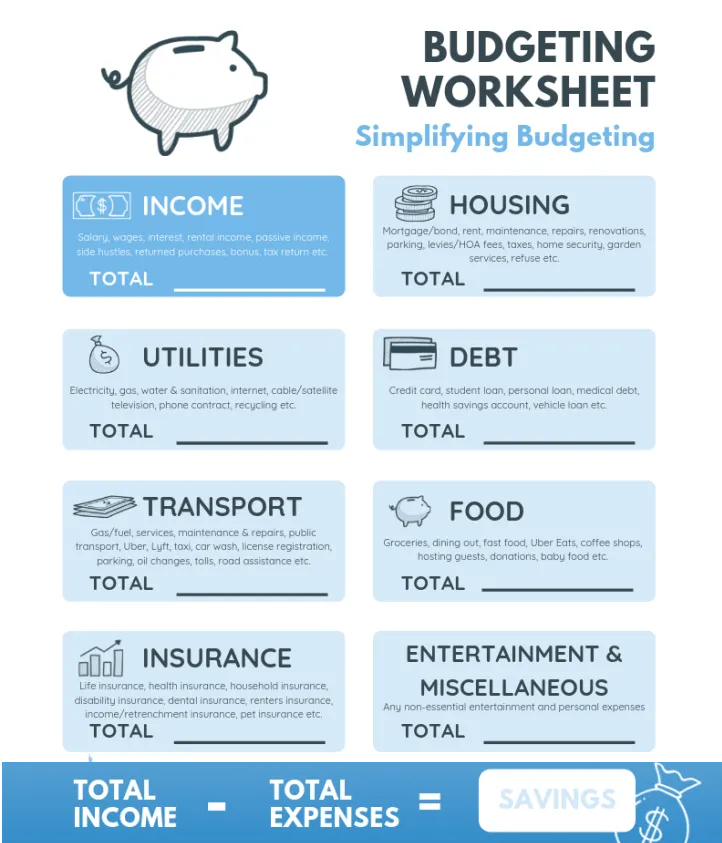
To create a budget, you need to track your income and expenses for a month. You can use apps, spreadsheets, worksheets, or envelopes to manage your budget. Here are some steps to follow:
- Record your income: This includes your salary, bonuses, tips, interest, dividends, and any other sources of income. If your income varies from month to month, you can use an average of the last three months, or the lowest amount you expect to earn.
- Record your expenses: This includes your fixed and variable expenses, such as rent, utilities, food, transportation, entertainment, clothing, insurance, debt payments, and any other costs. You can use your bank statements, receipts, bills, and online transactions to track your spending. You can also categorize your expenses into needs and wants, to help you prioritize your spending.
- Compare your income and expenses: This will show you if you have a surplus or a deficit at the end of the month. A surplus means you have more income than expenses, and a deficit means you have more expenses than income. Ideally, you want to have a surplus, so you can save and invest more. If you have a deficit, you need to reduce your expenses or increase your income, or both.
- Adjust your budget: Based on your comparison, you can make changes to your budget to improve your financial situation. For example, you might cut back on some of your wants, such as cable TV, coffee, or subscriptions, or you might look for ways to earn more money, such as a side hustle, a raise, or a promotion.
To maintain a budget, you need to regularly review and update your budget to keep it realistic and flexible. You should also avoid common pitfalls, such as overspending on credit, ignoring rising prices, or not allowing leeway. Here are some tips to help you stick to your budget:
- Review your budget monthly: This will help you monitor your progress, identify any problems, and make any necessary adjustments. For example, you might need to update your budget if your income or expenses change, or if you achieve or set new goals.
- Track your spending daily: This will help you stay on top of your expenses, and avoid overspending or impulse buying. You can use apps, spreadsheets, worksheets, or envelopes to track your spending. You can also use the 50/30/20 rule, which means spending 50% of your income on needs, 30% on wants, and 20% on savings and investments.
- Reward yourself occasionally: This will help you stay motivated and enjoy your budgeting journey. You can treat yourself to something you like, such as a movie, a meal, or a gift, as long as it fits within your budget and does not derail your goals.
How to succeed with budgeting?
Budgeting can be challenging, but it can also be rewarding. To inspire you, here is a success story from a real person who used budgeting to improve her financial situation.
Sara is a recent college graduate who works as a marketing assistant. She earns $3,000 a month, and has $30,000 of student debt. She wants to pay off her debt as soon as possible, and also save for a vacation. She decides to create a budget using the reverse budgeting method. Here is how she does it:
- She sets aside 20% of her income ($600) for her savings and investments. She splits this amount into three parts: $300 for her emergency fund, $200 for her vacation fund, and $100 for her retirement fund.
- She spends the remaining 80% of her income ($2,400) on her expenses. She allocates $1,000 for her rent, $300 for her utilities, $200 for her food, $100 for her transportation, $200 for her debt payment, and $600 for her entertainment and other wants.
- She tracks her spending daily using an app, and reviews her budget monthly using a spreadsheet. She makes sure she does not spend more than she earns, and that she meets her savings and debt payment goals.
- She rewards herself occasionally by going out with her friends, buying a new outfit, or ordering a pizza, as long as she stays within her budget.
After six months of budgeting, Sara has achieved the following results:
- She has reduced her social spending from $800 to $600 a month, saving $1,200 in total.
- She has built an emergency fund of $1,800, which can cover three months of her expenses in case of an emergency.
- She has started saving for a vacation, and has accumulated $1,200 in her vacation fund. She plans to go to Hawaii next year.
- She has increased her debt payment from $200 to $300 a month, using the money she saved from her social spending. She has paid off $1,800 of her principal, and reduced her interest rate from 6% to 5%.
- She has also started saving for her retirement, and has invested $600 in a Roth IRA account, which has grown to $650.
Sara is very happy with her budgeting results. She feels more empowered and confident about her money, and less stressed and anxious about her debt. She also enjoys her life more, and looks forward to achieving her goals.
Conclusion
Budgeting is a powerful skill that can help you improve your financial situation, and achieve your dreams. By creating and maintaining a budget, you can evaluate your income and spending, set realistic financial goals, and monitor your progress2. You can also avoid common financial mistakes, and enjoy your money more. Budgeting is not easy, but it is worth it. Start your budgeting journey today, and see the difference it can make in your life.
 ABC of Finance
One thought on “Budgeting”