Earnings before taxes (EBT), also known as pre-tax income or pre-tax earnings, are the net income that a company earns before paying income taxes. EBT is a measure of a company’s profitability and performance, as it shows how much of the revenue is left after deducting all expenses except taxes. In this blog post, we will explain what EBT is, how to calculate it, and why it matters for financial decision-making.
How to Calculate Earnings Before Taxes
EBT can be calculated by using either the top-down approach or the bottom-up approach. The top-down approach starts with the revenue or sales and subtracts the cost of goods sold (COGS), the operating expenses, and the non-operating expenses. The bottom-up approach starts with the net income and adds back the taxes. Both methods should yield the same result, as shown in the following formulas:
EBT (Top-Down)=Revenue or Sales−COGS−Operating Expenses−Non-operating Expenses
EBT (Bottom-Up)=Net Income+Taxes
For example, let’s say that a company has $1,000,000 in revenue or sales, $400,000 in COGS, $300,000 in operating expenses, $50,000 in interest expense, $10,000 in foreign exchange loss, and $80,000 in taxes. Using the top-down approach, the EBT is:
EBT (Top-Down)=1,000,000−400,000−300,000−50,000−10,000=240,000
Using the bottom-up approach, the EBT is:
EBT (Bottom-Up)=(1,000,000−400,000−300,000−50,000−10,000−80,000)+80,000=240,000
As you can see, both methods give the same result of $240,000 in EBT.
Why Earnings Before Taxes Matter
EBT is an important measure of a company’s profitability and performance, as it reflects how well the company manages its costs and generates income from its operations and investments. A high EBT indicates that the company has a strong competitive advantage, a high demand for its products or services, or a low cost structure. A low EBT indicates that the company faces intense competition, a low demand for its products or services, or a high cost structure.
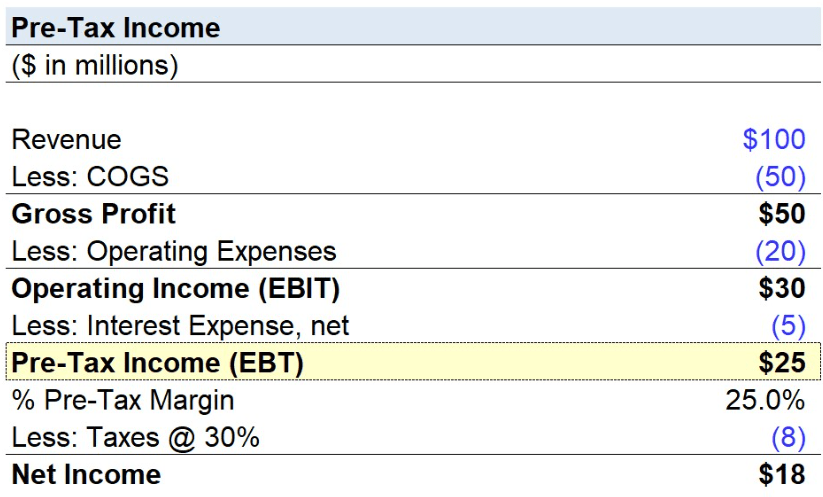
EBT is also an essential input for many financial analysis tools and techniques, such as:
- Income statement: EBT is the third and most important line item on the income statement, as it determines the net income of the company after deducting the taxes.
- Financial ratios: EBT is used to calculate various financial ratios that measure the profitability, efficiency, and performance of the company, such as EBT margin, return on sales, return on assets, and return on equity.
- Financial forecasting: EBT is the starting point for projecting the future income and cash flows of the company, based on historical trends, market conditions, and growth assumptions.
Conclusion
Earnings before taxes (EBT) are the net income that a company earns before paying income taxes. It is calculated by either subtracting the COGS, the operating expenses, and the non-operating expenses from the revenue or sales, or by adding back the taxes to the net income. EBT matters for financial decision-making, as it reflects the profitability, efficiency, and performance of the company, and influences the income and cash flows of the company.
 ABC of Finance