In the realm of finance, statistics is the compass that guides decision-makers through seas of uncertainty. The relationship between finance and statistics is not just important; it’s indispensable. Statistics provides the tools to analyze and interpret financial data, allowing for informed and strategic decision-making.
Statistics: The Science of Data
Statistics is the science of collecting, analyzing, interpreting, and presenting data. It enables us to convert raw numbers into useful information. In finance, statistical methods are used to assess risk, forecast economic trends, and make a myriad of decisions related to investments and policy-making.
Finance: The Management of Money
Finance, on the other hand, is all about the management of money. It’s concerned with the allocation of assets and liabilities over time under conditions of varying degrees of uncertainty and risk. Finance relies heavily on statistical data to make predictions about future market behavior and to analyze past performance.
The Symbiotic Relationship
The symbiosis between finance and statistics is evident in several key areas:
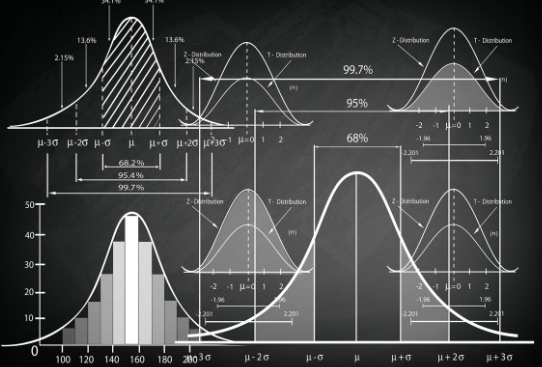
- Risk Assessment: In finance, risk assessment is crucial. Statistics provide the tools to measure and analyze the variability of financial returns. For example, the standard deviation is a statistical measure that quantifies the amount of variation or dispersion of a set of values. A low standard deviation indicates that the values tend to be close to the mean, while a high standard deviation indicates that the values are spread out over a wider range.
- Portfolio Management: Statistics are vital in portfolio management. The modern portfolio theory (MPT), for instance, uses variance and covariance to determine the optimal asset allocation that minimizes risk and maximizes return.
- Regression Analysis: This statistical method is used to understand the relationship between dependent and independent variables. In finance, regression analysis might be used to predict stock prices based on various economic indicators.
- Time Series Analysis: Financial markets are dynamic, and time series analysis helps in understanding and forecasting market trends. It involves analyzing a series of data points ordered in time to identify patterns that can be used to forecast future values.
Conclusion
The relationship between finance and statistics is a powerful one. Statistics serve as the foundation upon which financial theories are built and decisions are made. Without statistics, finance would lack the precision and clarity required for effective management of economic resources.
This blog post is a simplified exploration of the relationship between finance and statistics. It is intended for educational purposes and should not be taken as financial advice. For professional guidance in finance or statistics, please consult a certified expert.
 ABC of Finance